My response to the latest research surrounding trauma, memory, and finding physical relief.
I wanted to take a moment to respond to this article that came out recently, basically suggesting that the body does not keep the score.
This new paper challenges some of the cultural lore and current psychological understanding that comes about a lot because of Bessel van der Kolk’s book The Body Keeps the Score and this understanding of what is it that we really mean when we’re looking at the nervous system, the brain, and the body in relationship to post-traumatic stress symptoms.
One of the things that gets really tricky about this idea of “the body keeps the score of trauma” is this feeling that somehow the body all of a sudden becomes scary to us or that, if I do drop in and feel and sense my body,I might have a resurgence of memory or a strong uncomfortable emotion. And while some of that is true, the issue that I take with some of the language around “the body keeps the score” is that it maybe doesn’t also recognize that the body also carries so much wisdom and so much intelligence and kind of helps guide us towards healing. So, if we only associate the body as a source or harbinger of all of that negativity, of course, we’re going to be more prone to avoid it or not want to connect to it.

My Journey into Somatic Therapy
I’ve been a somatic therapist for over 30 years and I wanted to speak a little bit about what brought me into this field, what keeps me in this field, and what I like about this new article. The first thing that I’ll say is that as a somatic therapist, a body-centered psychotherapist, I came into this field because of my own experience of childhood trauma and the way that that showed up in my body.
For example, as a young child, I grew up in a house where there was divorce. There was a lot of strife. There was a lot of unrest in myself. We had a fire in our house when I was a young child. And because of this accumulation of early life experiences, I felt a tremendous amount of shame and insecurity and anxiety. And I felt it in my body. I didn’t necessarily have thoughts that accompanied all of this, but it showed up in my difficulty in falling asleep, even as a seven-year-old. It showed up in a difficulty in being able to sense and feel my body; and therefore, I couldn’t quite feel when I needed to go to the bathroom, and I had a lot of accidents.
As challenging and embarrassing and difficult those experiences were as a young child, they also helped guide me in the world. They helped direct me towards a field where the body could be more centralized in my journey of healing. I couldn’t talk myself out of those early experiences.
For example, one of the things that I did to fall asleep at night was I rocked and I rocked and I rocked and I rocked. I rocked so much that I broke multiple beds as a child. But why was I rocking? I was rocking because it was self soothing. I was rocking because I didn’t have the words to express how uncomfortable I felt and that I couldn’t settle into stillness.
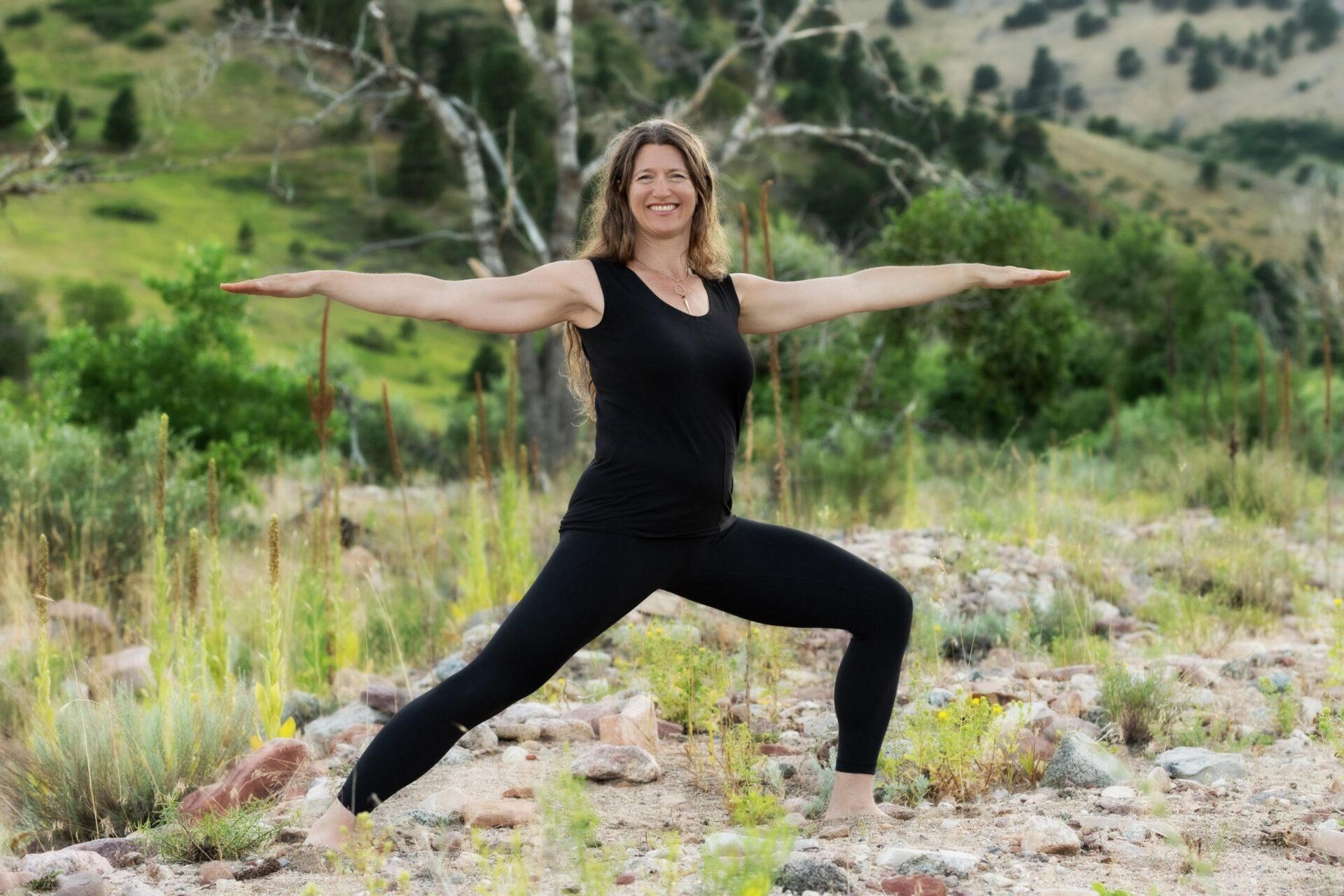
Even as of recently, sometimes I’ll greet those places in my body, those places that are still prone to holding tension. For example, I recently had a lot of tension in my hips and I went into a yoga class and I was attending a little bit more deeply to the feeling of my hips. It brought me right back to that feeling as a little girl rocking in my bed. And I imagined as I laid there on the yoga mat, bringing my adult self next to that little girl and just allowing myself to feel and breathe all of the fear that I carried in my little body as a seven-year-old. And through that compassion and through that attending, remarkably, not only did I have an emotional release, but my hips felt better afterwards. t’s those kinds of experiences that I’ve had personally and that I’ve had the opportunity as a yoga teacher and a somatic therapist to bear witness in so many others who have these somatic releases that accompany emotional release and a change in how we feel and think about ourselves.
That’s pretty phenomenal. It’s what we call a bottom-up source of healing. This new article, “The body does not keep the score”, is essentially saying that the body and brain are a complex network and that our brains do something really important. They try to predict the future. Our nervous systems and our brains have done this for as long as humans have been alive. They’re going to try to determine where is the threat, what is the threat, and how do we best protect ourselves from that threat? The brain and body are going to work together and determine if there is a potential threat.
Well, that protective system sometimes gets it right and sometimes gets it wrong. But in either case, if there’s a threat determination, it’s going to enlist the bodily systems of the autonomic nervous system to help keep you safe.
The Mind-Body Feedback Loop
One of the things that our brains do is that when we determine that there’s a perceived threat, it will send those signals into the body enabling the body to prepare us to protect ourselves. As a result, there’s a kind of reenactment of the somatic state linked to the trauma. The trauma doesn’t necessarily live here, but it lives in this body-mind relationship. It lives in the way that the brain is going to basically signal back to the body, hey, we’re still sensing that threat. It’s not over up here. And, hey, it’s not necessarily wise to let go of that vigilance, we’re going to be prepared to protect ourselves again—even if we have a false alarm, even if to some degree what we’re preparing for is over from many years ago and it’s no longer necessary for us to stay in that kind of self-protection.
The other thing to know about the brain and how our brains can sometimes loop around the traumas of the past is that we are experiencing a kind of loss of psychological flexibility. In my studies on resilience, one of the things that I know is that what fosters our resilience in response to stress is the capacity for psychological flexibility. It’s the ability to think about things in different ways. And also, as we change our cognition, we’re changing our emotion. We’re changing what we believe is possible. We’re changing that sense of threat. And our bodies are going to follow suit. Indeed what we want to bring back in is a kind of psychological flexibility that allows us to get out of those trauma feedback loops that become kind of a self-confirming bias towards negativity.

The Wisdom, Not Just the Score, of the Body
Another key piece about this article “The body does not keep the score” is that it clarifies that the body is not an archive of the traumas of the past. It’s not somehow that we are storing memories in our muscles or in our hips or in our jaw or in our shoulders. Although sometimes it feels that way. When I get on the yoga mat or when I’m guiding students on the yoga mat, very often people will say, “Well, when I get into that hip opener, I suddenly feel vulnerable. I feel teary. I feel an urge to cry.” Or, “I get into this part of my body and I can feel all this anger that’s ‘stored’ there.”
It may not be stored there, but what you’re tapping into, it’s not a repository of the memory, but it’s part of this mind-body feedback loop where there’s a sensation that your brain has an association to that might have a familiarity to a time in which you felt sad or scared.
So, how do we heal? When we’re healing, it’s not just about releasing this energy from the body because that’s not exactly how it works. It’s not again that the body is this repository or archive of the trauma. What we’re disrupting is the feedback loop itself where we’re aiming to create more psychological flexibility. We’re basically trying to interrupt the brain’s prediction system.
In my work very often what I’m cultivating is an orienting of your senses to here and now experience of safety so that you can go towards the feelings in the body. You can observe the automatic mental associations to that feeling in your body and then we can interrupt it. I don’t have to continue to be in that fear loop. I can change my physiology because I’m working with the power of my mind, my present orientation, and that sensing of safety. As I change my nervous system, it’s changing the predictive processing in the brain and it’s sending new messages back down to the body.
It will feel like a release. And it certainly will feel like a relief. Having just had that release from my hips, connecting back to that little girl who was so scared, I feel so much freer. I feel so much more joy and a lot more comfort walking around my neighborhood. I found a kind of psychological flexibility. I found the space in my mind to step out of the loop, to stop living in the past, and to come back into the present. Therein lies the change.
I’ll go ahead and link the article that I’m referencing here, as well as Dr. van der Kolk’s book, and also my book on healing complex PTSD, The Complex PTSD Workbook. I also recorded a short video response that you can watch here. I hope all of that helps you find your way to healing.